By Patrick Duncan | Commercial Safe & Lock
Table of Contents
- What Triggers ADA Automatic Door Opener Requirements?
- When Does a Building Need a Power Door?
- Ready to Make Your Entrances Compliant?
- Frequently Asked Questions
Key Takeaways
- The 2010 ADA Standards set performance rules for power-operated, power-assist, and low-energy door operators rather than requiring a business to automate any entrance.
- Operator class decides which ANSI/BHMA standard applies, and a vestibule entrance has to pair an exterior and interior door of the same type to keep clearances workable.
- Ask your local building department which code edition it enforces first, because that adopted edition, not the ADA by itself, usually decides whether a powered entrance is required.
- A powered entrance stays compliant through routine upkeep: a short daily sensor check by staff and a yearly inspection by an AAADM-certified inspector.
What Triggers ADA Automatic Door Opener Requirements?
ADA automatic door opener requirements come from Section 404.3 of the 2010 ADA Standards for Accessible Design, which sets rules for any power-operated, power-assist, or low-energy door a building installs: full-power doors follow ANSI/BHMA A156.10, low-energy and power-assist operators follow ANSI/BHMA A156.19, and each opening keeps its clear width whether power is on or off. Most facility owners get caught by one detail: the standards regulate door performance, not your choice to automate. Knowing which class governs each entrance keeps a retrofit from becoming a replacement order.
No section of the 2010 ADA Standards orders a commercial building to install an automatic opener. AAADM’s Technical Bulletin 108 says it plainly, noting that the intent of Section 404.3.2 is not to require automatic doors at vestibules. Two things change once a door is powered. First, the operator has to satisfy the ANSI/BHMA standard written for its class, and Section 1105 of the 2021 International Building Code can require automatic doors where occupancy thresholds are met. Second, the accessible route rules still apply: at least 32 inches of clear opening width is expected at an accessible doorway, and, per the ADA Knowledge Transfer Center, a facility built after January 26, 1992 must be fully accessible to people with disabilities. Commercial Safe & Lock technicians record the operator class, clear width, and hardware at each entrance, and that door-by-door baseline is what we document when you request a quote.
- Full-power automatic pedestrian doors follow ANSI/BHMA A156.10, now in its 2024 edition.
- Low-energy and power-assist operators follow ANSI/BHMA A156.19 (2019 edition), while ANSI also publishes A156.38 for low energy sliding and folding doors.
- No ADA section orders a business to install an opener, so the requirement begins when you specify or replace one.
- In a vestibule, at least one exterior and one interior door must use the same type of opener, per ICC A117.1 Section 404.3.2.
Rule of thumb: identify the operator class first
- Not every entrance needs a powered door, and not every powered door needs full power.
- The class you pick decides the standard: A156.10 covers full-power pedestrian doors, while A156.19 covers low-energy and power-assist operators.
- Match the class to traffic level, door weight, and vestibule clearances before hardware is ordered, because clearance and timing rules differ between full-power and low-energy units.
Operator classes, the standard that governs each one, and the edition or code section to record in your door schedule
| Door class or situation | Governing standard | Edition or code section | What the source requires |
| Full-power automatic pedestrian doors | ANSI/BHMA A156.10 | 2024 edition | Sets requirements for power operated doors and swing door operators, with provisions to reduce the chance of user injury or entrapment |
| Low-energy and power-assist doors | ANSI/BHMA A156.19 | 2019 edition | Covers power assist and low energy door operators; ANSI sells the A156.10 and A156.19 pair as one PDF set priced at $72.00 |
| Vestibule entrance doors | ICC A117.1, per AAADM Technical Bulletin 108 | Section 404.3.2 | At least one exterior and one interior door in the vestibule must have the same type of automatic door or gate opener, and the bulletin adds that IBC 2021 Section 1105 requires automatic doors under certain occupancy thresholds |
| Openers already in service | AAADM safety guidance | Annual inspection cycle | AAADM credits more than 50 billion safe automatic door openings and closings every year in the United States, and ties safe operation to proper installation plus annual inspection by an AAADM-certified inspector |
When Does a Building Need a Power Door?
Building codes, not the ADA alone, usually decide when a power door becomes mandatory. AAADM notes that IBC Section 1105 requires automatic doors under certain occupancy thresholds, so before planning a new build or renovation, confirm which code edition your St. Louis County or St. Charles County building department enforces.
Interior openings are where facilities slip. Manual doors on an accessible route are capped in opening force, which is why many owners add a low-energy operator instead of rebuilding an entry. The ANSI/BHMA power operated door standards set requirements for power operated, power assist, and low energy doors. Both editions also cover automatic pedestrian doors and swing door operators with provisions that reduce the chance of user injury or entrapment.
When you work with Commercial Safe & Lock, a professionally trained technician checks your hardware and the ADA automatic door opener requirements that the code edition your jurisdiction adopts imposes on a St. Louis, Missouri site before recommending a powered entry. The same code-first check guides every garage door installation we handle.
Upkeep keeps the door compliant. AAADM recommends annual certified inspections, plus a brief daily safety check by premises owners, the same routine we follow on each garage door opener project.
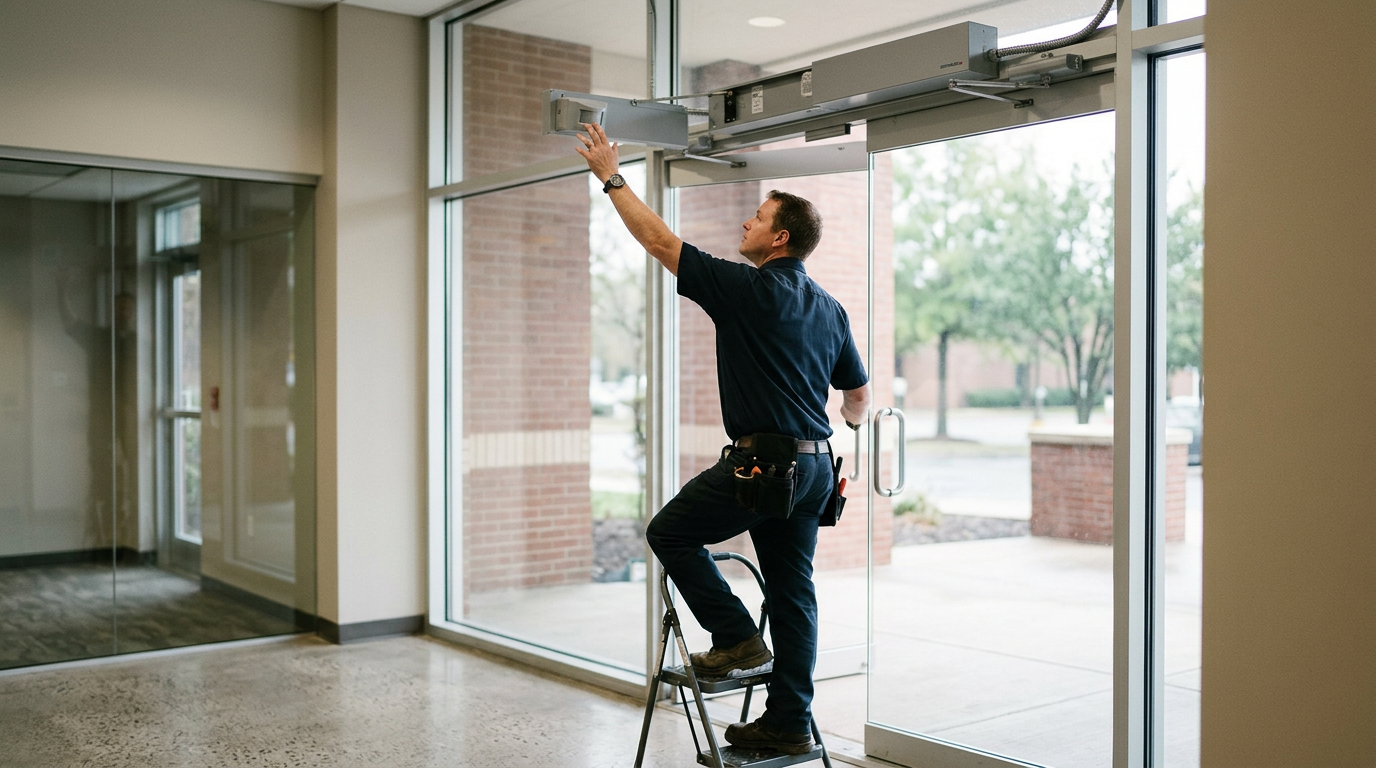
Approach sensors, hold time, and safety zones are what a daily check of a low-energy power-assist entrance covers.
Quick Facts
- 50 billion+ – Safe automatic door openings and closings each year in the United States, per AAADM
- IBC 2021 – Code edition whose Section 1105 requires automatic doors under certain occupancy thresholds
- Annual – Inspection cadence AAADM recommends, performed by an AAADM-certified inspector alongside a daily owner check
- 31 years – Commercial Safe & Lock has been family-owned and operated since 1995
Ready to Make Your Entrances Compliant?
Commercial Safe & Lock, a family business since 1995, installs and services automatic openers that meet ADA requirements. Our free on-site quote checks the door, hardware, and any needed door frame repair. An inspector certified by AAADM helps keep operation safe. Request your free on-site quote today.
Frequently Asked Questions
Can we retrofit an automatic opener onto our existing commercial doors?
A: Usually, yes. Most aluminum storefront and hollow metal doors accept an operator as long as the frame is square, the hinges are tight, and the closer is still in good condition. Adding hardware to an opening that already exists is a recognized path, because the ANSI/BHMA power operated doors set covers swing door operators as well as fully automatic pedestrian doors. If the frame is bent or the hinges are worn, door and frame repair comes first, because an operator mounted on a sagging opening inherits every alignment problem in it.
What is the difference between a low-energy operator and a full-power automatic door?
A: A low-energy operator opens slowly and with limited force, and it waits for someone to press a push button or step into a short-range sensor, so it suits offices, suites, and secondary entries with moderate traffic. A full-power door senses approaching traffic, opens faster, and depends on layered sensing features because it carries heavy flow, which is why the ANSI/BHMA set includes provisions to reduce the chance of user injury or entrapment. Many buildings use both, with full-power doors at the main entry and low-energy operators elsewhere. That split is where most scope changes come from, because the ADA automatic door opener requirements decide how a person gets through the opening, while the standards decide how the operator performs.
Does every door in a vestibule need the same kind of operator?
A: At a vestibule entrance, the pair has to match. AAADM Technical Bulletin 108 quotes ICC A117.1 Section 404.3.2, which requires that at least one exterior door and one interior door in a vestibule have the same type of automatic door or gate opener, either both fully automatic or both low-energy power assist. The reason is clearance. Maneuvering space through the doors changes with the door type, so mixing a full-power outer door with a low-energy inner door can break the accessible route at the one place every visitor passes through.
Do older buildings have to add automatic doors?
A: It depends on the building’s age and what the local code demands. Under the ADA, places of public accommodation and state or local government buildings built after January 26, 1992 must be fully accessible, while an older building must undertake readily achievable barrier removal, meaning work that can be carried out easily without much difficulty or expense, judged against existing structural conditions and the resources of the business. The same source notes that state and local building codes may require different or additional accessibility features, so the edition enforced at the permit stage can reach further than the federal baseline.
How often does an installed automatic door need inspection?
A: Yearly is the working benchmark for a hands-on check. AAADM’s safety guidance recommends proper installation plus annual inspections performed by an AAADM-certified inspector, and it pairs that with a brief daily safety check by the property’s own staff. Start with the presence sensor: walk toward the opening at a moderate speed from several angles, confirm the door begins opening as you approach, swings or slides open smoothly, stops without impact, and then closes after a short delay once you leave the sensor zone. For a two-way opening, repeat the same check from the other side.
What happens to an automatic door at the entrance when the power goes out?
A: That is a configuration decision, not a fixed outcome. Many operators can be set to release and hold open, or to go to free-swing, when power drops, which keeps the accessible route usable and the exit path clear, while other openings must hold their secured state instead. Which behavior is correct depends on whether the entrance serves as part of a means of egress or protects a restricted area, so branches and other secure spaces normally settle the question during bank security and access control planning rather than after the hardware is already mounted.
How much do compliant operators cost in 2026, and what moves the number?
A: Expect the price to move with three inputs: the operator class you choose, the condition of the door, frame, and hardware already in the opening, and how much access control the new operator has to communicate with, from card readers and request-to-exit sensors to door-position monitoring. Frame work and integration into a bank security upgrade add labor that a flat per-door price list never captures, which is why a 2026 figure quoted over the phone rarely holds. Commercial Safe & Lock walks the opening first and prices the work against what that specific door actually needs, so the ADA automatic door opener requirements and the hardware condition land in one scope instead of two separate change orders.