
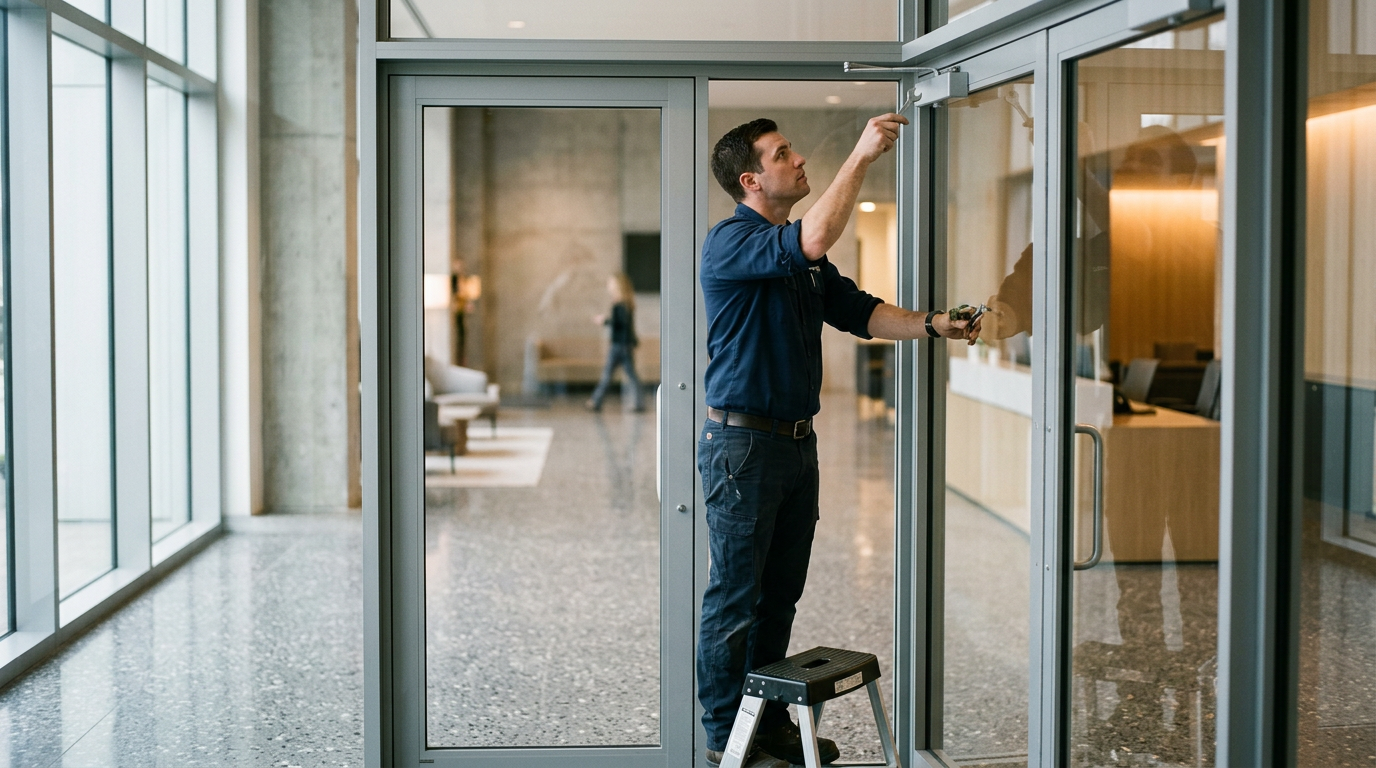
By Patrick Duncan | Commercial Safe & Lock
Table of Contents
- Why Does Storefront Door Repair Matter?
- What Causes Storefront Doors to Fail?
- Ready to Secure Your Storefront Again?
- Frequently Asked Questions
Key Takeaways
- A glazed commercial entrance usually fails through its hardware rather than its glass, so a quote that names only the panel has probably not looked at the closers, pivots, or frame.
- Most entry failures trace back to the closer, the hinges or pivots, and the lock cylinder, so listen for new sounds and watch for dragging before the door stops securing the building.
- Clearance is worth checking with a tape measure, because sag and frame movement can quietly narrow a doorway that once met accessibility requirements.
Why Does Storefront Door Repair Matter?
Storefront door repair is the service work that returns a commercial glass or aluminum entry to safe, code-compliant operation: replacing worn hinges, pivots, closers, panic hardware, locks, electric strikes, and weather stripping, then realigning door and frame so the unit latches, seals, and swings correctly. It covers hardware, not just glass, because that hardware is what keeps the opening secure.
A storefront is a glazed aluminum or steel entrance system, and it usually fails part by part rather than all at once. The wearing list is short and predictable: hinges and pivots, door closers, panic bars, electric strikes, locks and keyways, weather stripping, kick plates, and the door and frame themselves. When one of those components drifts out of adjustment, the symptoms multiply. A slab that drags keeps the latch from reaching the strike. A closer with too much force can slam the door and, over time, loosen the frame. The company’s commercial door services and door installation and repair pages describe that scope for businesses in the St. Louis area.
- Security: a door that never closes fully leaves the latch short of the strike, so the hardware is holding air instead of the frame.
- Hardware wear: hinges, pivots, and closers absorb every cycle the lobby sees, which is why those parts tend to age together rather than one at a time.
- Traffic and image: visitors form an opinion at the threshold, and a dragging or slamming entry is usually what they remember.
- Comfort and energy: torn stripping lets outside air move through the gap, which many owners describe as a cold or dusty patch near the door.
- Exit clarity: release hardware has to stay workable, so removing or blocking a device is a safety decision and not only a hardware choice.
- Frame condition: movement in the frame changes every measurement on the door, and our guide to commercial door frame repair lists the warning signs.
- Upgrade options: before choosing replacement, compare the types of security doors that fit a glazed commercial entry.
Before you approve a parts swap
- Ask the servicing company to name the code section or standard behind every locking or egress part it proposes.
- One entry can be governed by three different documents: a building code release provision, a federal safety rule for the crew, and a voluntary product standard.
- A written scope that separates adjustment, part replacement, and frame tear out is the practical test, because those are three different jobs.
- Commercial Safe & Lock has quoted commercial door and hardware work in the St. Louis area since 1995.
Governing code sections, federal safety references, and product test methods that can each touch one commercial entrance, as published by the issuing organization.
| Door Assembly | Governing Code or Standard | Documented Scope | Repair or Upgrade Decision |
| Electrically locked door on a retail entry | IBC, Sections 1010.1.9.7 through 1010.1.9.10 | Four systems are named: controlled egress, delayed egress, sensor release, and door hardware release | Specify the lock, the release device, and the reader together so nothing is left half wired |
| Retail exit door using delayed egress hardware | One of the four named locking systems | ICC states delayed egress systems may be used on required exit doors of retail establishments to reduce pilferage | Confirm the delay and release settings in writing before the hardware is ordered |
| Overhead or rolling door serviced on the same visit | 29 CFR 1910 or 29 CFR 1926 | OSHA routes door service work to the General Industry Standards, with repair or installation possibly under the Construction Standards | Ask which standard set covers the crew when one work order spans the entry and the dock door |
| Rolling, sectional, or high performance door assemblies | ANSI/DASMA 109-2017 | A standard method for testing and rating sectional doors to determine life cycling performance | Use published test methods when you compare hardware options instead of relying on estimates |
What Causes Storefront Doors to Fail?
Wear at the closer, the hinges or pivots, and the lock hardware causes the warning signs behind most storefront door repair calls we take. A door rarely quits all at once; it drifts, moving differently, sounding different, and stopping short of the latch.
At Commercial Safe & Lock, we often see entries that look sound from the sidewalk but slam shut, leak oil at the closer, drag on the frame, or rebound without latching. A tired closer loses fluid and stops metering speed. Loose hinge screws and worn pivot pins let a heavy door sag, pulling the latch out of line with the strike. Read our guide on when you need a commercial door locksmith, compare lock and key services when hardware is worn past adjustment, and keep 24-hour emergency locksmith coverage in mind for a door that will not latch. Catching these signs early usually means minor hardware work, not a full storefront door repair.
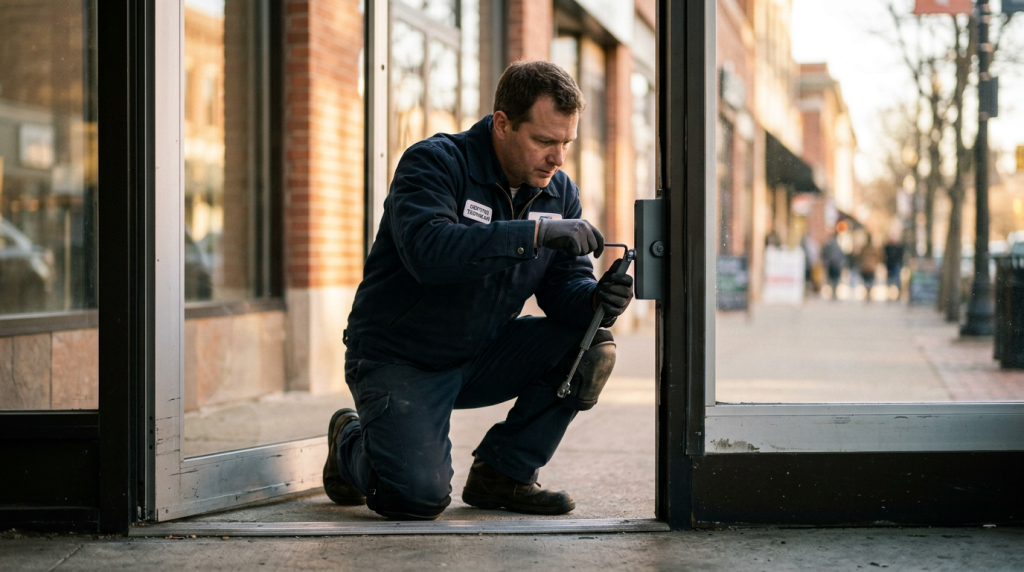
A leaf that rubs the frame usually starts at worn hinges, worn pivots, or a tired closer.
Quick Facts
- 36 in. – Minimum continuous clear width of an accessible route, per the U.S. Access Board
- 32 in. – Width allowed at points such as doorways, for up to 24 in. of distance
- 31 years – Commercial Safe & Lock has been family-owned and operated since 1995
- 24/7 – Emergency service availability when a door will not latch
Ready to Secure Your Storefront Again?
Commercial Safe & Lock has kept St. Louis businesses secure since 1995, and storefront door repair sits within our commercial services. Certified technicians fix the frame, glass, closer, and lock correctly the first time, so one call covers the door and your commercial security systems, with 24/7 emergency response and no surprises. Request a free quote and we will tell you exactly what the door needs. Contact us today.
Frequently Asked Questions
How much does storefront door repair cost?
A: Price follows the failed part, not the whole entry. Closers, hinges, pivots, electric strikes, and weather stripping are hardware swaps. A distorted frame, broken glazing, or a part that must be ordered adds labor and lead time. Commercial Safe & Lock inspects the opening and quotes the work before anything is ordered.
Can a damaged storefront door be repaired, or does it need replacing?
A: Repair the component when the fault is isolated. A sagging leaf usually points to worn pivots or hinges, and a door that slams or never latches points to a tired closer. Replacement becomes the honest answer when the frame is distorted, the anchors have failed, or the door no longer squares in the opening, because no hardware adjustment fixes a skewed opening.
Can I add a keypad or card reader without replacing my storefront door?
A: Usually, yes. The International Code Council explains that the four electrical locking systems the IBC permits on doors in the means of egress may be installed in concert with access control (ingress control) locking systems for enhanced security. Our commercial keyless entry guide covers the reader and credential choices that fit an existing frame.
Who should I call for commercial door and lock work?
A: Call someone who works on aluminum storefront systems regularly, because the hardware is commercial grade: surface closers, top and bottom pivots, multipoint locks, and kick plates. A door and hardware technician corrects alignment and locking in one scope. See what to expect from commercial locksmith services.
What upgrades make a storefront entry harder to break into?
A: Start with the weak points: secure the glazing, upgrade the cylinder and strike, restore a closer that pulls the door fully into the latch, and protect the lower rail with a kick plate. CSL’s commercial security services page shows how cameras, alarms, and access control layer onto that hardware.