By Patrick Duncan | Commercial Safe & Lock
Table of Contents
- Why Does Commercial Door Repair Matter Sooner Than You Think?
- What Causes Commercial Doors to Fail?
- Ready for Doors That Work Right?
- Frequently Asked Questions
Key Takeaways
- A documented scope that records which code, standards, or credential requirement applies to each opening makes it far easier to compare quotes and to defend a decision to repair rather than replace.
- Alignment drift and tired closer or latch hardware, not a cracked slab, explain most trouble on a heavily used entrance, so a stick, a slow close, or a late latch is the cue to act.
- Because electric egress locks must release when power fails and rated assemblies are labeled as tested units, an unlocking fault or a mismatched replacement part turns a routine fix into a compliance problem.
Why Does Commercial Door Repair Matter Sooner Than You Think?
Commercial door repair is the service work that returns a business entry, exit, or interior door assembly to its intended operation, so the door closes, latches, locks, and clears required openings. A qualified repair addresses worn or damaged hardware, alignment, and control components, and it defines where replacing individual parts stops and replacing the assembly begins.
The first signal is usually operational. Difficulty in operation, meaning a door that sticks, jams, or is hard to open and close, points to misalignment or worn components, and visible damage such as dents, cracks, or rust on the panel or frame compromises both integrity and appearance. That matters because a commercial door is rarely a single component. It is an opening that must carry egress, fire, accessibility, and credential requirements at the same time, and each requirement belongs to a different published standard, so the commercial door repair versus replacement decision is really a question of which layer has failed. Commercial Safe & Lock approaches these openings through its services as one scope covering locks, doors, and access control, and a 31-year record of family ownership since 1995 shapes how that scope is quoted.
- Egress and locking: electrical locking systems on doors in a means of egress are governed by IBC sections 1010.1.9.7 through 1010.1.9.10, including unlocking on loss of power.
- Fire rating: NFPA 80 covers fire doors and windows, and doors and hardware must be tested as an assembly to maintain labeling requirements.
- Accessibility: ADA and ANSI A117.1 requirements govern accessible openings and clear width.
- Credential and access coverage: keyless mechanical pushbutton units serve wood and metal doors, rated to BHMA A156 series standards.
- Timing: many facility managers report that ignoring early wear leads to more significant and costly work later.
Before comparing quotes, line the opening up against the authorities that govern it. The four resources below each set a concrete threshold, and those thresholds usually decide whether a component swap restores compliance or only a new assembly does. A written scope that names the applicable standard for each door makes that comparison straightforward.
Four published authorities that set the thresholds behind a repair-versus-replace decision on a business door.
| Authority or resource | Scope it governs | Concrete requirement | What it decides |
| ICC | Doors in the means of egress | IBC sections 1010.1.9.7 through 1010.1.9.10, with unlocking upon loss of power | Whether faulty egress hardware can be repaired or the opening needs rework |
| Dormakaba door hardware spec | Fire doors and exit door hardware | NFPA 80 and NFPA 252 fire tests; assembly testing to keep labeling, DHI hardware positioning | Whether a labeled assembly can keep its rating after hardware repair |
| NIST SP 800-116 Rev. 1 | Credential-based facility access | Risk-based selection of PIV authentication mechanisms under FIPS 201 | Whether updating credentials on the existing door beats a new opening |
| GSA PACS ordering guide | Physical access control systems | December 2025 edition, topology item 20.01, FICAM APL-compliant PACS under the FAR | Whether access control at the door must be upgraded, not just fixed |
Rule of Thumb Before You Approve the Work
- Ask which authority the quote answers: an IBC egress provision, a labeled fire door assembly under NFPA 80, an accessible opening under ADA and ANSI A117.1, or a credential standard such as FIPS 201.
- If none of those is named, the estimate covers the symptom, not the requirement, and the same opening tends to come back for a second call.
What Causes Commercial Doors to Fail?
Watch for four failure drivers on any busy opening: hinge and closer wear that pulls a door out of alignment, latch and strike misadjustment, rust or dents in the lower panel and frame, and electric hardware that no longer releases on schedule. Doors that swing hundreds of times a day wear first, so sticking, jamming, or a door that will not latch cleanly usually signals misalignment rather than a broken slab. Unusual noise, a slow close, or a hard slam points to tired operators and worn stops, while gaps at the top corner mean the frame has shifted. Codes tighten what those symptoms mean. Under the International Building Code, electrically locked egress hardware must unlock when power is lost, a requirement in section 1010.1.9.7, so a failing lock or sensor is a life-safety issue, not just an inconvenience. Hardware listings also assume the door and its components were tested as an assembly, which is why mismatched replacement parts on a rated opening can undermine labeling compliance. At Commercial Safe & Lock, our certified technicians inspect the whole assembly across St Louis, St Louis County, and St Charles County, and separate wear that a commercial door repair fixes from an opening that needs replacement. Our FAQ page explains how we rate each opening.
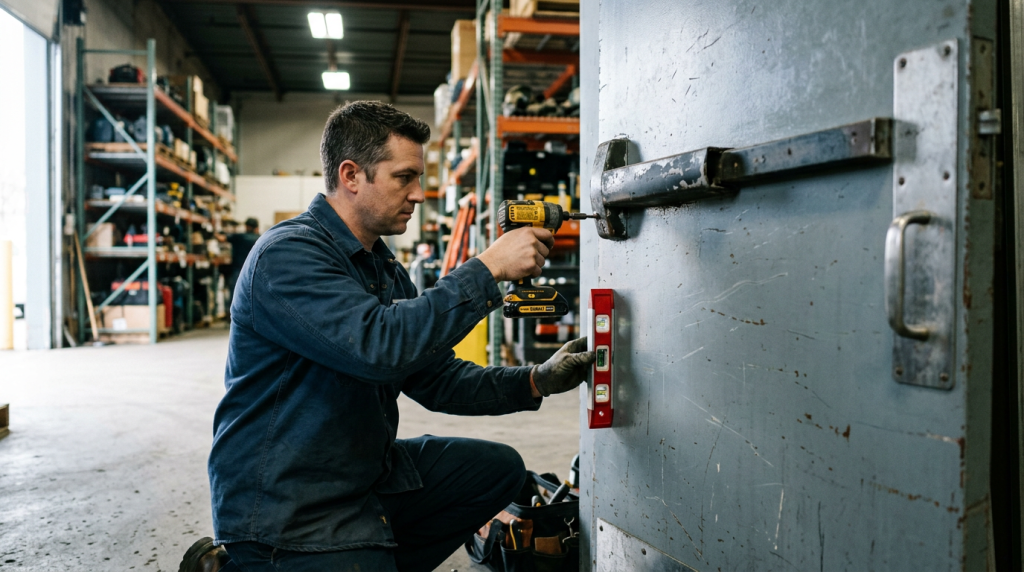
Closer wear, hinge sag, and frame shift are the first symptoms most facility managers notice on a busy entry.
Numbers Behind the Warning Signs
- 1010.1.9.7 – IBC section requiring controlled egress locking to release on loss of power
- A156 – BHMA hardware standard series referenced for door and hardware duty
- NFPA 80 – Standard for fire door and window assemblies that listed hardware must match
- Since 1995 – Family-owned Commercial Safe & Lock service, backed by certified technicians and a satisfaction guarantee
- 24/7 – Emergency coverage across St Louis, St Louis County, and St Charles County
Ready for Doors That Work Right?
Commercial door repair can involve electrical locking systems the IBC governs. Since 1995, Commercial Safe & Lock has been one point of contact for our clients’ locks, doors, and access control, fixed correctly, with no surprises. Request a free quote, any hour.
Frequently Asked Questions
How do I know whether my door needs repair or replacement?
A: Watch and listen first. An opening that sticks, jams, scrapes the floor, rattles, or will not latch usually needs an adjustment or a worn part swapped out, while dents, cracks, heavy corrosion, or a frame that has pulled out of true often mean the assembly itself is at the end of its service life. Repair keeps the existing frame and hardware in place. Replacement becomes the answer when the structure behind the panel is damaged.
Can a fire-rated door be repaired, or does it have to be replaced?
A: Often it can be repaired, but only while the assembly and its hardware still match their listing. A manufacturer’s hardware specification is blunt about this, requiring that door and hardware be tested together to maintain labeling requirements, and the same specification points to NFPA 80 for fire doors and windows and NFPA 101, the Life Safety Code. A fire door that has been drilled, burnt, warped, or fitted with unlisted parts generally gets replaced rather than patched.
Do electrically locked exit doors have to unlock when the power fails?
A: Yes, for the controlled egress arrangements the code allows. The International Building Code addresses electrical locking hardware on doors in a means of egress, starting with the controlled egress locking rules in section 1010.1.9.7, and that section covers unlocking upon loss of power to the locking system. So a repair on an access-controlled opening has to restore the release path, the sensor, and the signal, not just the latch.
How long does commercial door repair take?
A: It depends on the failure and on the parts. A cylinder, strike, hinge, or closer swap is usually a short visit, while realigning a door in its frame, welding a steel skin, refinishing a panel, or fabricating a replacement takes longer, and access control hardware may still need programming and testing after the mechanical work. Before the job starts, ask for the scope, the lead time on parts, and whether the crew can work around your business hours.
How do I match replacement hardware to what is already installed?
A: Start from the schedule, not the catalog. Door and hardware are written together, so most specifications reference a project hardware schedule, commonly Section 08710 Door Hardware, along with the Door and Hardware Institute standard hardware positioning dimensions and the BHMA A156 series of product standards. Hand the technician the manufacturer name, the function or model number, and a clear photo of any label on the door or frame, so the replacement keeps the same function, finish, and certification.
Does commercial door repair cover overhead and rolling steel doors?
A: Those openings carry their own wear items, springs, tracks, rollers, seals, and operators, so the decision tree looks familiar but the parts do not. A panel dented out of true or a bent track usually justifies replacing that section or the door, while a tired operator is a component job. For a related scope such as garage door opener installation on an overhead door, the same logic applies, replace what wore out unless the structure is compromised.
When should a broken door be treated as an emergency?
A: Call for same-day help when the opening cannot be secured at all, when a door that should lock stays open or stays shut, when a rated door will not close and latch on its own, or when broken glass and hardware leave an entry point exposed after a break-in or a storm. A door that only squeaks or drags slightly can wait for scheduled service. Commercial Safe & Lock is a family-owned company established in 1995 whose certified technicians handle door and hardware work, access control, and emergency calls, backed by a satisfaction guarantee.