By Patrick Duncan | Commercial Safe & Lock
Table of Contents
- What Does a Commercial Locksmith Do When a Business Door Fails?
- What Causes Emergency Commercial Locksmith St Louis Calls?
- What Preparation Speeds an Emergency Door Repair?
- What Hardware Details Must You Record?
- What Should the Tech Find on Arrival?
- How Do You Repair a Commercial Door Fast?
- Where Do You Start After a Door Failure?
- How Do You Choose Replacement Door Hardware?
- What Mistakes Slow a Door Repair?
- How Do You Check Hardware Compliance?
- Why Should You Get a Written Scope?
- Why Does a Commercial Door Stop Latching?
- How Do You Test Electric Strikes?
- What Code Rules Affect a Fix?
- Get Your Doors Secured Today
- Frequently Asked Questions
Key Takeaways
- Emergency door work is a code question as much as a repair question, because electrified locking hardware on an exit door is only allowed in certain occupancies and under set conditions.
- Most urgent commercial door calls are the delayed result of two earlier choices: lock hardware rated below the traffic it carries and electrified locking that was never checked against egress rules.
- Because the International Building Code treats electrified locking differently by occupancy class, confirming the room or building use comes before ordering replacement hardware.
- A written hardware record, one authorized contact on site, and a clear path to the door are what usually decide whether an emergency door fix closes in a single visit.
What Does a Commercial Locksmith Do When a Business Door Fails?
Commercial locksmith St Louis service refers to the specialized trade that installs, repairs, rekeys, and maintains the hardware that secures a workplace, from locksets, cylinders, and door closers to panic bars, master key plans, and access control. When one of those components fails, the job is to restore safe entry and quick exit before theft, injury, or downtime follows. Lock choices are also regulated: the 2018 International Building Code permits delayed egress locking in most occupancies, but not in Group H nor in Group A occupancies, except A-3 courtrooms. A practical response plan therefore starts with the door and hardware services that keep every opening operable, then moves to triage, temporary protection, and a code-compliant repair.
What Causes Emergency Commercial Locksmith St Louis Calls?
Two root causes drive most emergency commercial door failures: hardware that was never specified for the traffic a business door carries, and electrified locking that was installed without checking egress rules. Neither problem announces itself. Both end in a locked employee, a jammed exit, or a full door replacement that an early diagnosis would have avoided. Start with the lock standard. ANSI/BHMA A156.2 is the North American standard for bored and preassembled locks and latches, and hardware chosen without a published performance grade tends to wear first on a high-traffic opening. Then trace the power. The International Code Council notes that delayed egress locking systems are permitted in most occupancies, but not in Group H nor Group A occupancies with the exception of Group A-3 courtrooms. On a commercial locksmith St Louis call, that fail-safe versus fail-secure question, not the price of a new cylinder, decides the repair. Common scope questions are covered in the service FAQ.
What Preparation Speeds an Emergency Door Repair?
Prepare a written record for each opening, name one person on site who can authorize the work, clear the floor in front of the door, and photograph the failed lock, the strike, the closer, and any electrified hardware before anyone touches it. Those four steps decide whether the repair lands in one visit or two. When a door fails at closing time, the commercial locksmith St Louis owners need is the one who can already match a cylinder, an exit device, and a power supply to that specific opening. None of this requires special skills from your team, only a clipboard and a phone camera.
What Hardware Details Must You Record?
Start with the lock body and work outward, because the commercial locksmith St Louis managers call during a break-in is the one who already holds your hardware record. Note the manufacturer stamp on the faceplate or the exit device, the cylinder style, the backset, and whether the door opens on a change key, a floor master, or a grand master. Then record every electrified part on the opening, because a magnetic lock or a failed electric strike changes both the tools needed and the code questions the finished job must answer. The Missouri Department of Revenue’s locksmith tax matrix names lockout service, lock replacement, rekeying, and damaged door lock repair among the services it covers, so ask for a quote itemized the same way.
What Should the Tech Find on Arrival?
Then clear the working area. Move stock, carts, and boxes away from the opening, leave room to stage a drill and a replacement panel, and keep the access-control panel reachable rather than locked in a closed office. If the failed component is an electrified set on an exit door, the job is not only a repair. The International Code Council’s technical journal on electrical locking systems directs readers to sections 1010.1.9.7 through 1010.1.9.10 of the IBC. Ask that any proposed swap of a maglock or strike be checked against those sections. Commercial Safe & Lock brings professionally trained and certified technicians to that kind of work, so preparation and repair stay on one page.
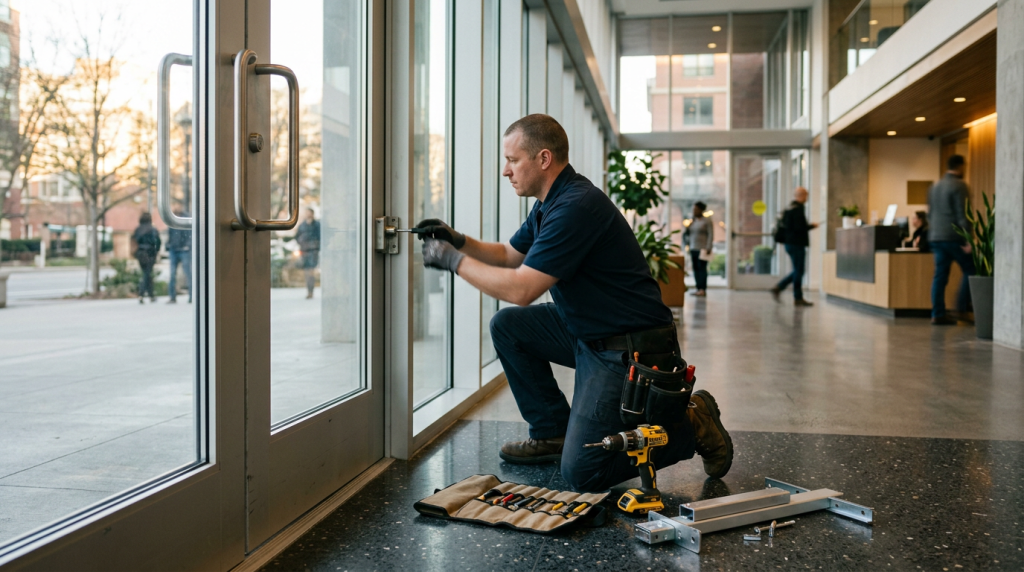
Staging the right cylinder, exit device, and power tools at the opening is what keeps an emergency door call on schedule.
- Pull the door schedule or original hardware list, then walk every opening and mark the ones that have failed, been forced, or been patched.
- Photograph each problem door twice: one shot straight on that shows the device and the closer, and one close-up that shows the manufacturer stamp and the cylinder.
- Write down the keying in use today, including who holds a grand master, so rekeying after a break-in or a staff change replaces a system rather than a single lock.
- Locate the power supply and control panel feeding any magnetic lock, electric strike, or delayed egress set, and arrange for a staff member who can disarm that zone.
- Get one written scope that itemizes labor, parts, and after-hours charges before the crew starts, then route it to whoever signs purchase orders.
Rule of Thumb
- Emergency door work stalls on missing information more often than on missing tools, so hand the technician a hardware record and a named site contact first.
- If the failed component controls how people exit the building, leave it out of service only until a certified technician evaluates the opening.
Work this list top to bottom before the crew arrives; the door schedule and the electrified-hardware record matter most. References below are the code sections, standards, and dated guidance each record should cite.
| Prep Item | What to Record Beforehand | Concrete Reference | What It Saves on Arrival |
| Door and hardware schedule | Manufacturer stamp, cylinder style, backset, and keying level for every opening | ANSI/BHMA A156.2-2022 covers bored and preassembled locks and latches by grade | Removes the wrong-cylinder guess that forces a second trip |
| Electrified exit hardware | Which openings run magnetic locks, electric strikes, or delayed-egress sets; delayed egress is barred in Group H and Group A occupancies except A-3 courtrooms | IBC sections 1010.1.9.7 through 1010.1.9.10 | Keeps a fast fix from blocking a required exit |
| Monitored or recorded egress files | Whether badge or camera monitoring covers the exit, and who is authorized to disarm the zone | 2024 I-Codes renumber monitored or recorded egress to 1010.2.9 and add 1010.2.14 for elevator lobby exit access doors | Stops a crew from defeating hardware that records the exit |
| Scope and approval paperwork | Itemized labor, parts, and after-hours charges, plus the buyer who signs off | Missouri Locksmiths Tax Matrix, revised 03-28-2025, lists lockout service, rekeying, and damaged door lock repair | Shortens the approval wait before work starts |
How Do You Repair a Commercial Door Fast?
Repair an emergency commercial door in five moves: stabilize the opening, document the damage, confirm egress duties, spec the hardware, then test and hand over. That is the order a good commercial locksmith St Louis crews follow, because the fastest result comes from sequence, not speed. At Commercial Safe & Lock we send trained, certified technicians to doors across St. Louis, St. Louis County, and St. Charles County.
Where Do You Start After a Door Failure?
Make the building safe before hardware gets ordered. Keep the opening protected with a temporary measure that still allows egress, and station staff there if the door will not hold. Then document: photos of the lock body, strike, hinges, closer, frame, and any surrounding wall, plus notes on deadbolt throws, latch alignment, and closer sweep. Cycle the door by hand, then test the credential, the reader, and the power supply so you can separate mechanical wear from electrical faults. Write down opening width and height, hand of the door, frame material, and existing keying, because that sheet sets the scope and the parts list for the visit.
How Do You Choose Replacement Door Hardware?
With the building secured, decide repair or replace for each component. Match lock function to traffic: restricted exit, classroom style, or passage. For product performance, purchasers of bored locks certified to that standard can expect hardware to meet its published rating, and ANSI/BHMA advises consulting the full standard for the complete list. Where hardware is electrified, confirm the locking method against the electrical locking provisions of the International Building Code, then let the tech set the latch, strike, and closer and cycle every credential.
- Define the scope in writing: failure type, door material, hand, opening size, and how many openings are affected.
- Photograph the lock, strike, hinges, closer, and frame condition, then collect the existing keying and credential details.
- Confirm egress duties before you spec anything, because electrified hardware changes what is permitted on an exit door.
- Order hardware to the ANSI/BHMA A156.2-2022 functions and grades the doorway actually needs, not the cheapest match.
- Install, align the latch and strike, set closer sweep and speed, then cycle the door with every credential.
- Update key control and log the change so the next technician inherits an accurate record of the opening.
Code check before the patch
- Do not let a fast repair override exit duties. The International Building Code sets the conditions under which electrical locking is permitted on doors in the means of egress, and those conditions vary by occupancy.
- Confirm the rule for your occupancy before the tech leaves.
What Commercial Safe & Lock Brings to a Door Call
- 31 – Years in business as a family-owned operator
- 24/7 – Emergency availability for door and lock failures
- Free – Quotes before work is scheduled
- 3 – Missouri are as served: St. Louis, St. Louis County, St. Charles County
What Mistakes Slow a Door Repair?
Most repair delays begin before a technician ever arrives. Five decisions cause them: calling after the failure instead of before, specifying hardware that ignores egress code, hiring by price alone, treating electronics and mechanical hardware as separate vendors, and skipping a written scope. A search for “commercial locksmith St Louis” will return dozens of options, so the real differentiator is what you ask for on the phone. Commercial Safe & Lock has handled commercial door and hardware work since 1995, and the pattern is consistent: the job that stalls is the one where the buyer never confirmed who owns the code question. Write the failure down first, note the door type and hardware you can see, and describe the outcome you need rather than the fix you assume.
How Do You Check Hardware Compliance?
Never order replacement hardware from a photo. The usual error is swapping a failed lock or electrified exit device for whatever fits the hole, then learning the assembly does not match how the door is listed. Ask the installer to confirm the opening against means of egress requirements before anything is ordered. Under the IBC, delayed egress locking is permitted in most occupancies but not in Group H, and Group A exceptions are narrow. Specify mechanical locks to a published standard as well, because the full standard ANSI/BHMA A156.2 covers bored and preassembled locks and latches rather than generic shelf hardware. A single line item naming the standard, the function, and the finish prevents the callback, and it keeps substitution off the table.
Why Should You Get a Written Scope?
Get the scope in writing before anyone touches a door, and require a named contact for the code question. Verbal estimates invite two failures: mid-job substitutions and a bill nobody authorized. This matters for exit hardware in particular, because the Missouri Department of Revenue describes installing door closers, panic bars, and emergency exit door devices as locksmith services in its industry guidance for the trade. Use that same specificity in your request. Name each opening, the hardware function, whether power is present, and what happens when it is not. Ask what is included if the strike, the closer, or the credential reader is replaced. A provider that will not commit those details to a document is the mistake, not the price.
- Document the failure, then photograph the door edge, the strike, and any exit device label.
- Confirm how the opening is listed before ordering replacement hardware or electrified components.
- Write the scope: each door, its function, power present or absent, and the fail-safe behavior you expect.
- Name one vendor who owns both the mechanical hardware and the access control wiring.
- Ask for the technician’s certification and the after-hours dispatch process in writing.
Why Does a Commercial Door Stop Latching?
Start by isolating the fault before you order parts. Note whether the latch, the strike, the closer, or the electrified hardware is the component that fails, then test the door with the power disconnected. Many doors that look broken are misaligned instead of damaged, and sagging leaves the bolt short of the strike hole. Document what you see, because that detail is what a commercial locksmith St Louis facilities call in for, and it decides whether the repair is a strike adjustment, a hinge or closer correction, or a full hardware replacement.
How Do You Test Electric Strikes?
Work the electrical and the mechanical sides separately. Confirm the credential is being accepted at the reader, then confirm voltage at the device itself, since a controller can issue a release signal while a failed transformer never delivers the power. Next check alignment: a strike that sits even a few millimeters off holds the latch out of the pocket, so the door appears unlocked while the bolt actually stays extended. Finally, watch fail-safe versus fail-secure behavior when power drops, and correct any hardware that no longer matches the way it is supposed to release.
What Code Rules Affect a Fix?
Some faults cannot be cleared with the closest available part, and the reason is usually life safety. The ICC code guidance on electrical locking hardware explains that delayed egress systems are permitted in most occupancies but not in Group H, or in Group A-3 courtrooms. Missouri tax treatment also changes with the job: per the Missouri Department of Revenue, taxable locksmith services cover lock repair, panic bar work, and security hardware upgrades. Commercial Safe & Lock specifies hardware that matches both duties.
Get Your Doors Secured Today
When you hire a commercial locksmith St Louis businesses rely on, you get one crew for locks, doors, and access control, fixed right the first time. Our certified technicians answer around the clock, and Commercial Safe & Lock quotes every emergency commercial door repair at no cost. Before any hardware goes on an exit door, review the International Code Council on electrical locking systems permitted by the codes.
Frequently Asked Questions
What counts as an emergency commercial door problem?
A: The commercial locksmith St Louis calls that qualify as emergencies usually share one trait: an opening that cannot be secured or cannot be opened. In practice that means a front door that will not latch after a break-in attempt, a seized cylinder on an employee entrance at closing, a stuck electric strike that traps staff inside, a panic bar that no longer retracts, or a door left hanging on failed hinges overnight. If the opening exposes people, cash, inventory, or records, or it blocks the way out, treat it as urgent rather than routine maintenance.
What should I do in the first hour after a forced entry or door failure?
A: Work through four steps before anyone touches the door. First, stop forcing the leaf, because added pressure bends the frame and can turn a hardware repair into a door and frame replacement. Second, photograph the door, the hardware, the frame, and the damage, then leave failed parts in place so the technician can match model numbers. Third, restrict access by moving staff to another entry and closing off the affected zone, and if keys went missing or were possibly copied, treat that whole key group as compromised. Fourth, have someone on site who can say what failed first and what changed recently.
Who should I call when a door fails after hours or on a weekend?
A: The quickest route is the commercial locksmith St Louis facilities already keep on file, because a provider who has walked your openings knows the hardware, the frame type, and the egress path before a truck is dispatched. With no such relationship in place, screen for three things: round-the-clock emergency coverage, real comfort with commercial door and hardware work rather than residential key cutting, and a written scope that names parts and labor separately. Commercial Safe & Lock provides 24/7 emergency service with professionally trained and certified technicians, backed by family ownership since 1995 and a satisfaction guarantee.
Will the technician replace the whole door or only the hardware?
A: Most emergency calls turn out to be hardware calls. If the frame is still plumb, the door squares in the opening, and the latch engages, then servicing or swapping the cylinder, strike, door closer, hinges, or exit device restores security at a much smaller scope. The door or frame joins the repair when the leaf is bent or torn, when the frame is pulled loose from the wall, when hinges have ripped out of the surrounding material, or when a fire-rated assembly is damaged enough that its listing no longer holds. Ask for that reasoning in writing before work begins.
Can a commercial exit door stay locked and still satisfy egress rules?
A: Sometimes, but never automatically. The International Code Council explains that the International Building Code permits several electrical locking arrangements on doors in the means of egress, each carrying occupancy-specific conditions, and it notes that delayed egress systems are allowed in most occupancies but not in Group H nor in Group A occupancies, with Group A-3 courtrooms handled as an exception. Because the governing provision depends on your occupancy type and the code edition your jurisdiction has adopted, ask the installer to name the section that applies to each door rather than approving hardware out of habit.
Will my invoice carry Missouri sales tax on emergency door repair labor and parts?
A: That depends on which line you are examining, and the state publishes guidance for this industry. The Missouri Department of Revenue Locksmiths Tax Matrix summarizes the taxability of locksmith services and of tangible property sold by a locksmith business, while cautioning that it may not cover every situation because the result can turn on the facts of a specific transaction. Have your provider itemize labor, parts, and any freight separately, and if a line remains unclear your business can request a letter ruling rather than guess. Keep those invoices with your door records for warranty and audit use.
How do I keep the same door from generating repeat emergency calls?
A: Treat recurring hardware failure as a maintenance gap rather than bad luck. Keep a simple door schedule that records every opening, its hardware set, and its model numbers. Put high-traffic entries on a scheduled inspection for sagging leaves, loose closers, and worn strike faces, and match the hardware grade to how hard that door is actually worked. Control keys and credentials so staff turnover triggers a planned rekey instead of a midnight failure. Repeat emergencies often begin with one over looked opening that everyone assumed was fine.