By Patrick Duncan | Commercial Safe & Lock
Table of Contents
- Why Does Safe Opening St Louis Matter?
- Why Does a Business Safe Stop Opening?
- What Causes the Most Safe Lockouts?
- What Should You Check First?
- How Does a Safe Opening Actually Work?
- Why Does Non-Destructive Entry Come First?
- What Should You Have Ready Beforehand?
- Which Safe Opening Option Fits Your Situation?
- Request a Quote for 24/7 Emergency Help
- Frequently Asked Questions
Key Takeaways
- Commercial safe work is graded by how long the door resists tool attack, so a trained assessment before choosing a method usually saves the hardware and shortens downtime.
- According to ANSI/UL 608, burglary resistant ratings for vault doors and modular panels are based on how long the assembly withstands tool attack, so knowing a unit’s rating should shape the entry method chosen.
- Weak cells, an undocumented combination change, worn drive parts, and a shifting door explain most commercial lockouts, and all four give early warning long before the safe refuses to open.
A safe opening St Louis engagement is professional work that restores access to a locked, malfunctioning, or compromised commercial safe, vault door, or high-security lock when normal entry methods, a known combination, or a working key no longer open the door. Common triggers include a dead electronic lock battery, a worn keyway, a lost or never-documented combination, or a door that sagged out of alignment. UL 608 rates burglary-resistant vault doors and modular panels by how long they withstand attack from mechanical tools, electric tools, or cutting torches. That is why Commercial Safe & Lock treats a locked safe as an assessment first, method second, whether the call is a 24/7 emergency or a planned upgrade.
Why Does Safe Opening St Louis Matter?
A safe opening restores access to a locked, code-forgotten, or mechanically failed safe while preserving the door, the lock hardware, and the contents inside. For commercial accounts, a safe opening St Louis operators rely on is a security procedure first and a lock call second, because the method chosen determines whether the safe stays serviceable or has to be replaced.
Why does the method matter so much? Rated vault hardware is engineered to buy time against tool attacks, not to survive careless entry. Under the UL 608 vault door standard, burglary resistant ratings for vault doors and modular panels are set by the length of time an assembly withstands attack with common mechanical tools, electric tools, or cutting torches. That is why a drill-first approach can ruin hardware that was still repairable, and why the resulting downtime lands on your staff rather than the vendor. Commercial Safe & Lock technicians diagnose the failure mode first, then choose the least destructive entry method that keeps the safe reusable. Service scope and response questions are answered on the CSL FAQ page.
Why Does a Business Safe Stop Opening?
Start with the cause, not the drill. In most commercial jobs we field in St Louis, Missouri, the reason a safe will not open is something a technician can repair: drained batteries in an electronic lock, a combination that changed without anyone logging it, a handle or spindle that no longer drives the boltwork, or a door that has shifted on its hinges. Each of those conditions announces itself before it fails completely. A keypad that dims or stays silent when pressed is usually a power problem, not a lock problem. A dial that spins without the usual resistance, or a handle that turns loose, points to worn internal parts. A door that has to be lifted or shoved sideways to release tells you the hinges or frame have moved. Owners looking for safe opening St Louis help are almost always describing one of these symptoms without knowing which one, which is why diagnosis comes before any destructive method at Commercial Safe & Lock. Noticing the warning early is the difference between a hardware repair and a replaced door.
What Causes the Most Safe Lockouts?
Power and code problems sit at the top of the list because they are invisible until someone needs the safe at closing time or in front of a customer. Electronic locks draw current continuously through a keypad, a solenoid, and an audit trail, and cells that still read fine on a meter can sag the moment a solenoid demands real load. Misremembered combinations rank second: many businesses hand the code to new staff with no written change log, so the current setting becomes a guess. Mechanical wear follows, and it matters most where hardware carries a tested rating. Underwriters Laboratories burglary resistant vault doors by the length of time they withstand attack from common mechanical tools, electric tools, or cutting torches, a reminder that this security is a measured performance rather than a marketing claim. Careless prying can damage the very assembly that rating was meant to protect.
What Should You Check First?
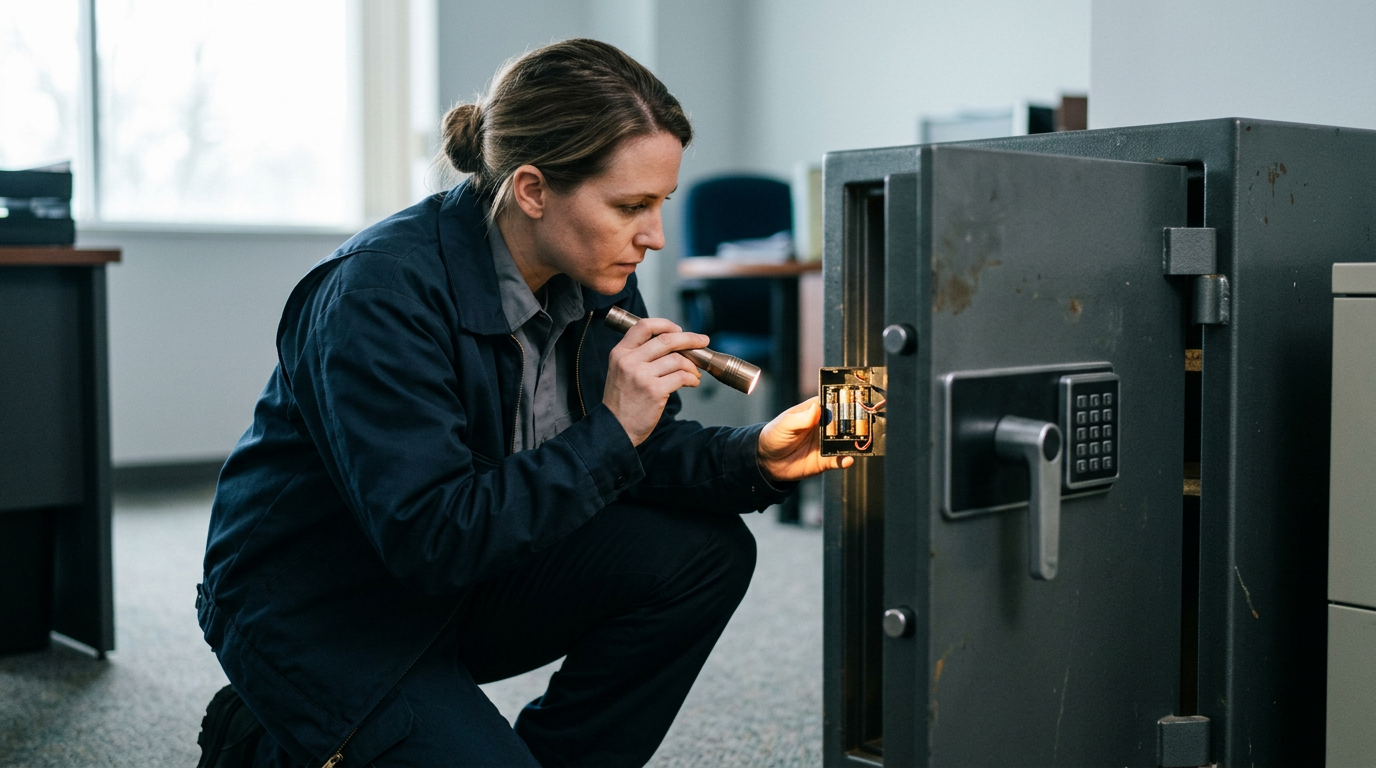
Check the simplest item before you escalate anything. Put in fresh alkaline cells of the exact size the lock specifies, using one matched set rather than a mix of old and new, because mixed cells are a frequent cause of a keypad that beeps but never retracts the bolt. Then verify the combination against your own written records instead of a coworker’s memory, working the dial slowly past each number and listening for the gate to drop. Do not hammer a handle, force a dial, or lean on the door to test it, since bent boltwork turns a quick repair into a full teardown. If those two steps do not solve it, that is the point where a safe opening St Louis technician should take over. The remaining causes need inspection lights, the right pulling tools, and a reading of the lock internals that no hallway attempt can produce safely in St Charles County or anywhere else across our service area.
Certified technicians start with the power supply and the current combination before considering any destructive method.
- A keypad that dims, flickers, or stays dark when pressed, which usually means weak cells or a loose battery connection.
- A dial or handle that turns freely with no resistance, a sign of a worn spindle or damaged drive parts.
- A door that must be lifted, pushed, or jiggled to latch or release, which points to sagging hinges or a shifting frame.
- A logbook showing repeated failed attempts, the fingerprint of a code that changed without documentation.
- Moisture, corrosion, or dust inside the battery compartment or around the lock escutcheon.
Expert note
- Most commercial safes fail electrically or administratively before they fail mechanically, so confirm the power supply and the current code before approving any destructive entry.
- Keep a written change log for every combination, and store spare keys and emergency numbers outside the secured room so a lockout never becomes a break-in of your own making.
Experience and tested ratings behind every call
- 1995 – Family-owned and operated since
- 31 – Years serving commercial security needs
- 1/2 hour – Class 1 net working time rating under UL 608
- 2 hours – Class 3 net working time rating under UL 608
How Does a Safe Opening Actually Work?
The lock type first should be identified attempt the least invasive entry method next, and reserve drilling for last. That sequence is how a professional opening works, and it applies to every safe opening St Louis technicians handle, whether the unit is an older dial safe or a modern electronic lockbox. The mechanism behind the craft is patience rather than force. On a mechanical dial lock, the operator feels for the gates on the flywheel dropping over the fence as the combination turns, which is why recovering a forgotten combination means methodical rotation through several revolutions instead of one lucky guess. On an electronic lock the path is different: the technician checks battery condition, verifies the keypad and solenoid wiring, and follows the manufacturer’s override or recovery procedure before touching the door itself. Ratings also set expectations about what the hardware can absorb. UL Standards publishes the vault door rating requirements in ANSI/UL 608, and those tests measure how long an assembly withstands attack by common mechanical tools, electric tools, and cutting torches, so rated hardware is designed to buy time rather than to stop an attack outright.
Why Does Non-Destructive Entry Come First?
Because the lock is usually the least expensive part worth saving. Manipulation, decoding, and controlled dial rotation leave the internal works intact, so the same lock can often return to service after the door swings open and the customer pays for an opening instead of a recovery plus a replacement hardware order. Force is expensive in ways that are not obvious during a phone call. Grinding a hinge or drilling an exploratory pattern across the door face can damage the spindle, the relocker, and the door lining, and that damage frequently turns a repair into full door or modular panel replacement. There is also a documentation benefit. A technician who records which non-destructive method was used, and why a destructive step be came unavoidable, gives the property owner a clear written basis for the repair plan and for any insurance conversation that follows, rather than a story about who last touched the safe.
What Should You Have Ready Beforehand?
Gather the make, model, and serial number of the safe or vault door, along with any combination, key code, or master code your records hold. A qualified technician will also ask you to confirm ownership or authority to open the unit before work begins, which protects the contents as much as the custodian. Then prepare the site and the story. Clear the area around the door so the operator can see the hinges, the boltwork, and any prior damage, and note when the problem started, whether the last opening worked normally, and whether anyone has already tried to force it. Those details determine the method and the duration, and they are what separate a same-day safe opening St Louis businesses can rely on from a return trip for parts. That diagnostic-first discipline is how Commercial Safe & Lock describes handling a job properly, and it reflects a family-owned operation that has served commercial customers since 1995.
Decision Point at the Door
- Non-destructive methods, such as manipulation, decoding, or a manufacturer recovery procedure, come first because they leave the lock reusable.
- Drilling or cutting is a last resort, since it can damage the spindle, the relocker, and the door lining beyond economical repair.
- Ask for a written note of the method used and any damage caused, because that record supports both the repair plan and any insurance discussion.
Which Safe Opening Option Fits Your Situation?
Choose the least destructive method that still gets you inside. Non-destructive manipulation by a certified technician is the first option on most safe opening St Louis service tickets, because it preserves the lock, the door, and the contents. Drilling is the fallback when a dial, spindle, or lock mechanism is already damaged, and that route leaves component repair behind. Full door replacement is the option commercial buyers weigh most carefully, because a new door has to match the rating of the assembly it replaces. Those ratings are documented numbers, not guesses. The ANSI/UL 608 standard covers burglary resistant vault doors and modular panels intended for financial institutions, commercial, industrial, and mercantile properties. It grades each assembly by the net working time needed to force entry, with classes from 1/4 hour up to 2 hours, and it excludes attacks using a burning bar or explosives. Edition 7 of the standard is the active version, last revised in March 2022. Commercial Safe & Lock recommends deciding the opening method against the door’s rated class, not the other way around.
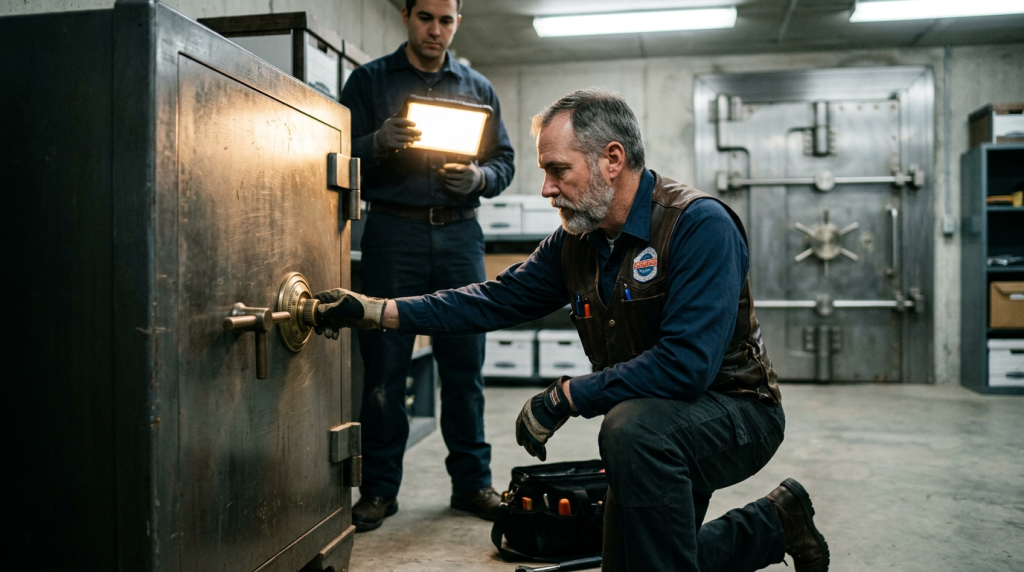
Non-destructive manipulation preserves the lock and the door, which is why it is attempted before drilling.
Net working time ratings for vault doors and modular panels under ANSI/UL 608, Edition 7.
| Burglary-Resistant Class | Rated Net Working Time to Entry | Attack Methods in Scope | Standard Status Note |
| Class M | 1/4 hour | Common mechanical tools, electric tools, cutting torches, or any combination | Covered by ANSI/UL 608 Edition 7, listed active |
| Class 1 | 1/2 hour | Mechanical tools, electric tools, cutting torches, alone or combined | Published Nov 30, 2004; last revision Mar 07, 2022 |
| Class 2 | 1 hour | Mechanical tools, electric tools, cutting torches, alone or combined | ANSI Approved Mar 07, 2022 |
| Class 3 | 2 hours | Mechanical tools, electric tools, cutting torches, alone or combined | Burning bar (thermal lance) and explosives are outside scope |
Request a Quote for 24/7 Emergency Help
Commercial Safe & Lock answers every safe opening St Louis business can face, with certified technicians who get the job done right the first time. From lock and door work to the vault doors relied on in financial and commercial properties, CSL is a one-stop shop, family-owned since 1995. Tell us what needs opening, and our 24/7 emergency response brings a technician on site when the job cannot wait.
Frequently Asked Questions
How long does an emergency safe opening in St Louis usually take?
A: Nobody can honestly promise a fixed clock time before a technician sees the unit. Duration depends on the safe or vault door, the lock or combination mechanism involved, the condition of the hardware, and whether a non-destructive method is workable. A through-dial or key issue that yields to manipulation can be finished quickly, while a damaged lock, a compromised hinge side, or a heavy door can turn the job into a longer, multi-step process. Get a free quote and describe the unit, the brand plate if it is readable, and what you already tried, and you will get a far more reliable expectation than any generic estimate.
Will my safe be drilled or otherwise damaged when it is opened?
A: Not necessarily. Many locksmiths begin with non-destructive approaches such as manipulation, dialing, or key work, and drilling is a deliberate last step chosen when those methods cannot move the mechanism. Two things shape the outcome: the actual condition of the lock, and who is doing the work. If the lock can be repaired or replaced afterward, the hardware can be returned to full function even when a hole is required. Ask directly whether the technician will attempt a non-destructive opening first, and what the repair path looks like if drilling becomes necessary.
Can I get a safe opened after hours or on a weekend?
A: Yes, if you call a provider that carries emergency coverage. Commercial Safe & Lock is available 24/7 for emergency service, which matters when cash, documents, or equipment are needed before the next business day, or when a locked unit is the only barrier to opening a store or a bank area. Have the make and model, your relationship to the property, and any documentation of ownership ready, because a technician who arrives with proof in hand can start work immediately instead of waiting on a verification step.
What do the burglary-resistant ratings on a vault door actually mean?
A: The number is a tested resistance window, not a guarantee against every attack. ANSI/UL 608 is the standard that governs these doors, and the UL 608 standard scope covers vault doors and modular panels used in financial institutions and commercial, industrial, and mercantile properties, with Class M rated for 1/4 hour, Class 1 for 1/2 hour, Class 2 for 1 hour, and Class 3 for 2 hours of net working time to effect entry. The same standard also states that it does not cover attacks with a burning bar or explosives, so a door’s class describes one defined test scenario. Knowing your door’s class tells a technician what hardware you have and what opening approach makes sense.
How should I prepare before a safe-opening technician arrives?
A: Clear the area around the unit and give the technician room to work, since doors and drawers need to swing and tools need access. Gather anything that documents ownership or authority, combination records, key inventories, service history, and the model or serial plate if it can be read. Note exactly what happened, whether a combination was lost, a key broke, the dial spins freely, or the door moved and then bound. If the unit sits behind a door with its own access control, arrange that access in advance, because a locked room can delay the actual safe work by longer than the opening itself.