By Patrick Duncan | Commercial Safe & Lock
Table of Contents
- How Do Biometric Access Control Systems Work?
- What Should Facilities Plan Before Installing Biometric Readers?
- Secure Your Facility With Certified Help
- Frequently Asked Questions
Key Takeaways
- A door opens on a biometric match only because three parts agree in sequence, the template captured at enrollment, the comparison made at the reader, and the release signal sent to the strike or maglock.
- The rooms that pay for two-factor entry are the ones holding cash, medication, servers, and vault contents, where a borrowed card makes the audit log name the wrong person.
- Mounting height, permitted locking hardware, warranty length, and the inspection path are already fixed by code and design standards, so they belong on the drawings before a reader is chosen.
- A door-by-door hardware check, a reader-to-software integration test, and a written retention policy should all be settled before any biometric hardware is ordered.
How Do Biometric Access Control Systems Work?
Biometric access control systems unlock a door only after a reader matches a scanned fingerprint, face, iris, or palm vein pattern against an enrolled template. Businesses reach for them where keys, cards, and PIN codes are too easy to lose, share, or copy. A matched scan signals an electric strike or maglock to release, and every entry is logged.
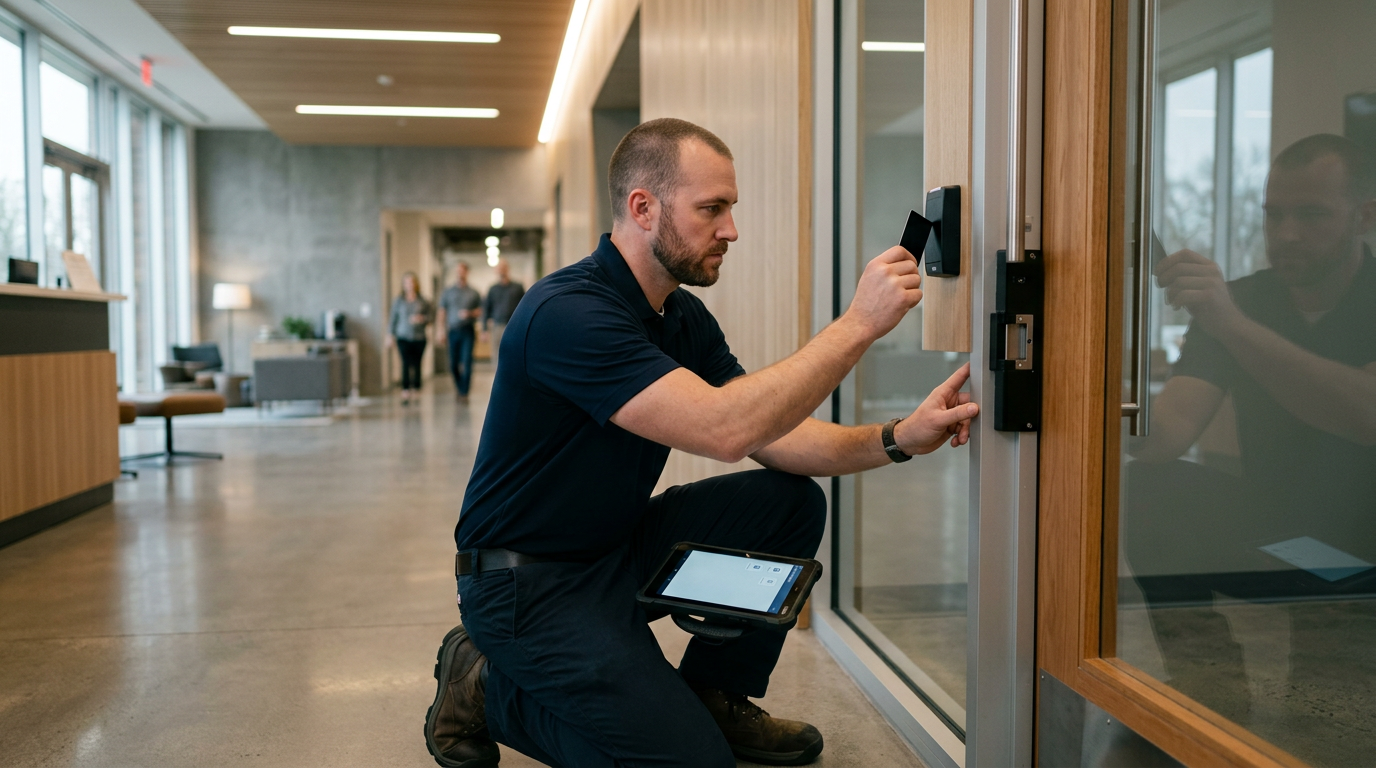
Enrollment is the step most buyers underestimate. A technician captures the trait once, and the software converts it into a numeric template, an encrypted set of measurements rather than a stored photograph. At each entry, the new scan is measured the same way and compared against that template. A match sends the release signal to the electric strike or maglock, and the controller records who entered, at what time, through which door. Reader type follows the room. Fingerprint, iris, face, and palm vein each trade convenience for assurance, and none works if the door behind the reader is misaligned or under-wired. Arlington Fire Rescue’s access control guide requires the full plan review and inspection process to be followed, and deviation can mean rejected plans. State law rides alongside the hardware: Washington’s Chapter 19.375 RCW covers the enrollment, disclosure, and retention of biometric identifiers, so policy paperwork has to keep pace with the install. Plan readers, strikes, and wiring on one door schedule, so request a quote before hardware is ordered rather than after.
- Fingerprint readers suit interior office doors, stockrooms, and break rooms, where a quick touch scan matters most.
- Iris readers verify from a short distance, which fits server rooms and areas where gloves or worn fingerprints cause problems.
- Face readers move a line of people through a lobby or main entrance faster than one scan at a time.
- Palm vein readers add assurance at vaults, cash rooms, and pharmacy storage, often paired with a card for two-factor entry.
- Match the trait to the loss a room cannot absorb, and let cards cover the low-risk hallways.
Where a biometric reader earns its place
- Rule of thumb: pair a card with a biometric scan at vaults, server rooms, cash rooms, and pharmacy storage, where a lent card or a shared PIN is the real exposure.
- A scan proves something a person is, a card proves something a person has, and two-factor entry requires both before the controller releases the strike.
- Compare reader mounting height, egress locking hardware, warranty terms, and the local permit path against the governing standards before any reader is specified.
- Commercial Safe & Lock has planned commercial door security as a family-owned company since 1995, so schedule a site walk to see how a reader, an electric strike, and door prep fit one schedule.
Code, standard, and permit thresholds that shape a biometric door install, drawn from ICC code commentary, the Ohio OFCC design manuals, the Arlington Fire Rescue access control guide, and the University of Kentucky 087100 standard.
| System element | Governing standard | Figure, code section, or edition | Install note |
| Card reader mounting height | ADA reach limits carried in the Ohio door hardware plan | 44 inches to the bottom of the reader | One consistent height keeps handicap entrances and card readers within ADA limits |
| Electric locks on exit doors | IBC electrical locking systems, summarized by the ICC code commentary | Sections 1010.1.9.7 through 1010.1.9.10, four permitted systems | Each of the four may be installed in concert with access control (ingress control) locking for enhanced security |
| System warranty and quality assurance | Ohio Section 28 13 00 | One (1) year from substantial completion; NFPA 730, NFPA 731, National Electric Code, UL, ANSI TIA/EIA-568, 569, 606, 607 | Defective components replaced at no extra cost to the owner for parts or labor within the warranty period |
| Permit and inspection | Arlington Fire Rescue guide | 2021 IFC Edition, guide updated March 2025; triple permit fee plus citations for unpermitted work | Access control and delayed egress submittals clear plan review and inspection before finish out |
| Campus-wide design standard | UK standard 087100 | Revised 9/2025, applied to both the healthcare campus and the education campus | Deviations require approval from the Capital Projects Project Manager and the UK Police Department |
What Should Facilities Plan Before Installing Biometric Readers?
Verify door condition, locking hardware, existing card software, and a written biometric data policy before ordering anything. Facilities that skip this get readers on frames that never latch cleanly, hardware that cannot talk to the software running their badges, and consent gaps that surface in an audit. Start with the openings: sagging hinges, worn frames, and tired closers keep an electric strike or maglock from holding, which is why storefront door repair usually precedes access work. At Commercial Safe & Lock, our certified technicians build that opening-by-opening survey into every free quote across St. Louis, St. Louis County, and St. Charles County before recommending biometric access control systems. Confirm new readers share a protocol with your current card software, or phase the rollout site by site. Put those decisions in the drawings early; a university access control standard makes the design team responsible for folding its requirements into the drawings and specifications. Then write the consent, retention, and deletion rules for employee templates: Washington’s biometric identifier law covers enrollment, disclosure, and retention. Set mounting height at the same time; Ohio’s door hardware planning guide places card readers at 44 inches to the bottom, which keeps the device within ADA limits, and keep a backup credential for employees who cannot enroll.
Frames, closers, hinges, and strike alignment are checked before any reader is mounted.
Quick Facts
- 44 inches – Reader height to bottom that keeps the device within ADA limits, per Ohio’s door hardware and access control planning guide
- Design team – Responsibility for folding access control requirements into drawings and specifications rests with the design team, per a university facilities standard
- Chapter 19.375 RCW – Topics a state biometric identifier statute regulates: enrollment, disclosure, and retention
- 31 – Years Commercial Safe & Lock has served commercial sites, family-owned since 1995
Secure Your Facility With Certified Help
A thorough door hardware plan starts with a walk of every entry door.
About Commercial Safe & Lock: family owned since 1995, with certified technicians and a satisfaction guarantee. We offer 24/7 emergency service. Request your free quote today.
Frequently Asked Questions
How much do biometric access control systems cost for a commercial building?
A: There is no single list price per opening, because the total tracks four variables: how many doors you put under control, which reader technology each one gets, what hardware changes the door needs, such as an electric strike, a power supply, or new wiring, and how far the software has to reach into badge printing, visitor management, or video. Count the doors first, then sequence the decision the way a published access control plan guide does, where step 6 is to discuss capabilities and options, and costs. Ask for line item pricing by opening so two bids can be compared on the same basis, and confirm that the commercial key and lock services on a retrofit include the mechanical work behind the reader.
Can a fake fingerprint or a photograph fool a door reader?
A: Reader quality decides it. Modern units add liveness detection, which means the sensor looks for signs of living tissue before it runs a match, so a flat photograph, a printed image, or a molded replica typically fails instead of opening the door. Rooms with serious risk should still require two factors, for example a card plus a fingerprint, so no single spoof or one missing finger is the only key to a vault, a server room, or drug storage. Put the verification method in writing in your scope, along with how the system logs and reacts to a false accept.
What happens to the doors when the power or the network fails?
A: Every opening is set in advance to behave one of two ways. Fail safe hardware releases the lock when power drops, which is the normal choice on an exit route, while fail secure hardware keeps the door locked until power returns, which suits a records room or controlled storage. A battery backup at the panel keeps readers, credential records, and event logs running through a short outage, and a network drop generally leaves the controller making decisions locally instead of reaching for a hosted service. Review that mode choice door by door with your local fire code official before you order hardware, because controlled doors and exit paths are decided together.
Should the system be specified during construction or added to an occupied building later?
A: Both paths work, and the retrofit usually costs more labor per opening and more surprises. Institutional projects treat door hardware and access control as one scope, and a university design standard is written as a resource for the designer of record, with its access control and door hardware requirements to be reviewed by the design team and incorporated into the contract documents. In an occupied building the same decisions get made door by door, and Commercial Safe & Lock walks each opening so the key and lock work behind the reader, the frame condition, the strike box, the hinge swing, and a power source are all settled before equipment is quoted.
Are biometric access control systems a privacy problem for employees?
A: They become a data handling question the moment a template is stored, so treat enrollment as a documented process instead of a quick walk up. State law can reach this data directly, since Washington’s biometric identifier statute, Chapter 19.375 RCW, covers enrollment, disclosure, and retention of biometric identifiers. Ask your provider where templates live, whether that is on the reader, on the controller, or in a hosted service, how long records are kept after someone leaves, and whether employees sign a consent notice before their first scan. Put the retention and deletion rules in the same scope document as the hardware.