By Patrick Duncan | Commercial Safe & Lock
Table Of Contents
Table of Contents
- What Does Commercial Door Maintenance Cover?
- What Signs Show a Door Is Wearing Out?
- Why Do Doors Fall Out of Alignment?
- How Do You Isolate the Real Failure?
- In What Order Should You Inspect Doors?
- Should You Repair, Retrofit, or Replace?
- Ready to Secure Your Doors?
- Frequently Asked Questions
Key Takeaways
Key Takeaways
- Scheduled inspection, lubrication, and hardware adjustment usually keep commercial doors in service longer than waiting for a failure to force a repair.
- Unusual noise, a door that no longer lines up with its frame, or a lock that will not engage are practical signals that professional service is overdue.
- A standing schedule of inspections for closers, hinges, locks, rollers, and access hardware catches wear before it costs you security, energy efficiency, or compliance with International Building Code egress requirements.
Commercial door maintenance is the scheduled inspection, adjustment, and repair of doors, frames, closers, hinges, locks, and access hardware in business buildings. It refers to the preventive work that keeps entry points operating safely, securely, and predictably, rather than waiting for a door to seize, sag, or fail during business hours.
A written door upkeep schedule keeps loose hinges, sagging frames, and tired closers from turning into an open door at closing time. Regular inspections, lubrication, and prompt repairs keep doors in service, while noise, misalignment, or lock failure mean it is time for a contractor, as Trillium Facility Solutions notes. A provider with family-owned experience handles that sequence in order, so one service visit closes several small risks.
What Does Commercial Door Maintenance Cover?
Routine door care is the scheduled inspection, adjustment, and repair work that keeps entry doors, fire-rated assemblies, and overhead doors closing, latching, and locking as they were installed to. It covers the hardware people touch all day, including hinges, closers, locks, rollers, and tracks, along with the sensors and access systems that control entry, as this maintenance overview describes. Why does it matter? Commercial doors take constant abuse, so wear accumulates quietly and failures rarely arrive with warning. Worn hardware weakens security, raises energy costs, and can leave a facility out of step with the fire and accessibility rules already governing the building. Controlled egress locking carries code duties set in the International Building Code, including unlocking when power is lost, as the ICC egress locking guidance explains. A stuck or sagging door also stalls foot traffic and can shut down a loading dock or a classroom in seconds. Left alone, a minor alignment issue lets the frame warp, turning a quick adjustment into a full replacement. Commercial Safe & Lock treats doors, locks, and access control as one scope, so problems are diagnosed and fixed correctly the first time rather than patched repeatedly.
What Signs Show a Door Is Wearing Out?
Wear almost always announces itself before a door fails. Most commercial doors in St Louis facilities give warning in the same order: a change in sound, then a change in how the door moves, then a change in how it latches or locks. At Commercial Safe & Lock, a family-owned team since 1995, technicians see that same pattern across St Louis County and St Charles County properties, where heavy daily traffic and gradual building settlement quietly loosen hardware. Noise is the earliest clue, a squeak, grind, or click that was not there last month. Resistance follows, when a door needs a shove to clear the threshold or the frame. Latching problems come last and cost the most, because a door that closes without securing leaves the space unsecured without anyone noticing. Routine door care exists to catch the first two stages, when a simple adjustment is inexpensive, rather than the third, when a warped frame or a failed closer usually means replacement. Between visits, consistency matters: compare how the same doorway feels at the start of each month, and route common questions to our support FAQ.
Why Do Doors Fall Out of Alignment?
Buildings move, and hardware answers first. Framing shifts as a structure settles, hinge screws back out of their mortises, and the door stops sitting square in the opening, which is why a shove to open a door reads as a misalignment signal rather than a habit. According to Trillium’s door guide, buildings settle, hinges loosen, and doors stop fitting like they should, and ignoring that condition only makes it worse, because eventually the frame warps and the repair turns expensive. Squealing hinges belong to the same chain, since rust and dirt build up over time and make the door harder to move smoothly. Check the three contact points on any suspect doorway: hinge screws, the strike, and the bottom rail near the threshold. Loose fasteners stay cheap; a frame out of square turns a quick adjustment into a replacement, a distinction explained on our FAQ page.
How Do You Isolate the Real Failure?
Test the door in sequence, because door upkeep works best when each stage is judged separately rather than all at once. Start with the swing: does the panel move freely from the latch side, or does it hesitate? Then check alignment, then whether the latch actually catches, then whether the electric release hardware holds and releases on command. A door that closes but never registers as secure points at hardware rather than at the opening device. On electrified exits, ICC’s code guidance on doors in the means of egress notes that controlled egress locking requirements, including unlocking upon loss of power, are included in section 1010.1.9.7 of the IBC. So a lock that behaves differently after an outage belongs on the service ticket, not in a complaint file. For fire-rated openings, a commercial door hardware specification states that door and hardware are tested as an assembly to maintain labeling requirements. That is why labeled openings are handled as complete assemblies rather than as separate parts.
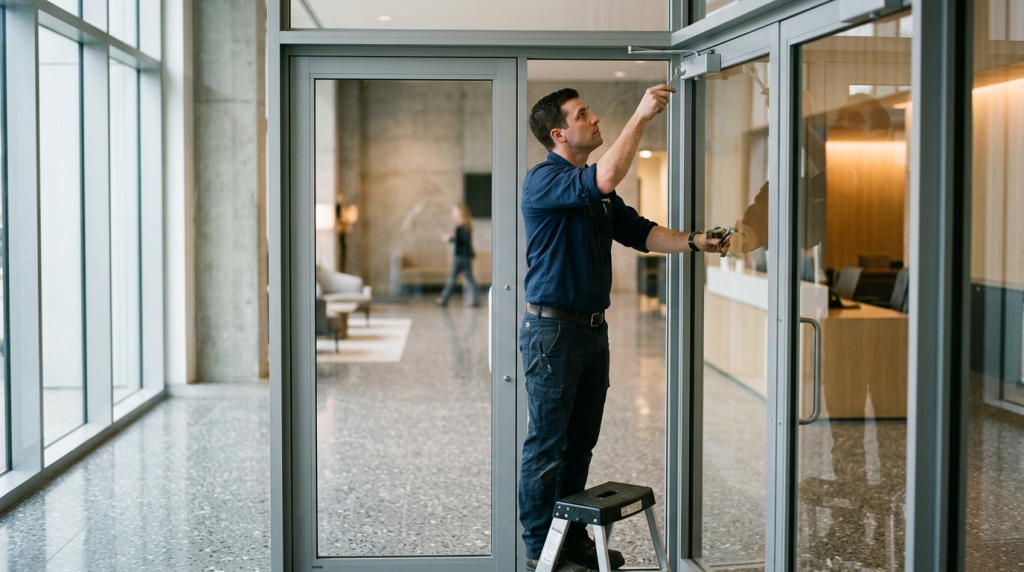
A closer adjustment and hinge-line check at the start of a doorway walkthrough
- Squeaking or grinding on every swing
- A door that drags along the threshold
- Latches that catch late or miss entirely
- Uneven daylight gaps around the frame
- Loose handles, closers, or hinge screws
Expert Note
Sound First, Security Last
- Judge a doorway by what changed, not by its age: a sudden symptom usually points to one loose component, while a slow change points to settlement or worn parts.
- Write down the doorway number, the sound or resistance noticed, and the date, so the trend is visible on the next visit.
- When the latch stops holding, treat that opening as unsecured and schedule service the same day instead of waiting for the next planned cycle.
Info
Quick Facts
- 31 years – Commercial Safe & Lock has been family-owned and operated since 1995
- 24/7 – Emergency door, lock, and access control response for area businesses
- 5 to 10 years – Window in which a door cycled only 3 to 5 times per day may need major part replacement without routine upkeep
In What Order Should You Inspect Doors?
Follow the door’s movement path, from free swing to alignment, then latching, then locking, and finally the electrical and access-control components that release it. That order is the backbone of door upkeep, because each stage depends on the stage before it and skipping ahead hides the real fault. Adjusting a closer on a sagging leaf wastes the setting, and replacing a lock that only looked defective because the strike sat out of position buys a part nobody needed. A manufacturer’s hardware specification section states that dependency directly: door and hardware must be tested as an assembly to maintain labeling requirements. Worked in order, the sequence turns a scattered service call into a controlled process: the technician isolates the point of failure, corrects the mechanical condition that produced it, then verifies that locking and life-safety functions still operate as intended. Commercial Safe & Lock approaches every door and hardware call with this sequence in mind, because fixing the wrong component leaves the actual fault in place. Skipping to the final stage is where budgets leak, since a symptom at the latch is frequently rooted in a hinge or frame problem two steps earlier. Document what was checked, what was adjusted, and which doors are close enough to failure to need parts ordered before the next visit.
- Record the baseline. Walk every leaf in the building and log hinge wear, closer speed, latch engagement, gaps, and error codes before touching a tool.
- Correct the swing. Tighten or replace hinges and pivot hardware first, because a sagging leaf throws off every adjustment downstream of it.
- Reset alignment. Shim the strike, check the frame and threshold for binding, and confirm the door closes into its designed opening position.
- Adjust the closer. Set closing speed, latch action, and hold-open timing only after the leaf hangs true, so the hardware governs movement rather than fighting it.
- Service locking and access hardware. Lubricate moving parts, verify deadlatch operation, test credential readers and request-to-exit devices, and confirm each one behaves as the hardware schedule intends.
- Document the visit. Log what was adjusted, which parts are near failure, and which doors need follow-up work before the next scheduled door upkeep visit.
Neutral
Rule of Thumb: Sequence Before Substitution
- Adjust hardware in the order the door carries its load: hinges and pivots first, then frame and strike alignment, then closer settings, then locks and electric release hardware.
- If a door still fails after you correct the stage you are working on, stop and re-check the stage above it instead of replacing another part.
- Keep the written record with the door, not just in the invoice, so the next visit starts from known baselines rather than a fresh guess.
Should You Repair, Retrofit, or Replace?
Weigh three realistic options before spending anything: reactive call repair, scheduled preventive inspections, or a targeted hardware retrofit. Which one fits depends on how often each opening cycles and whether the assembly still carries its original listing, and for most buildings the most durable path is the alternative that stops wear before it reaches the frame.
Reactive work is the lowest cost per visit, but it compounds quietly across a facility. Sticking doors that go unadjusted warp frames, turning a small adjustment into a full replacement. Scheduled inspections, the option most facility teams underweight, catch loose hinges, tired closers, and sagging leaves while they are still small, adjustable problems. A retrofit addresses a different need, because keyless mechanical pushbutton hardware is specified for wood and metal doors, so an access upgrade does not require new openings. Replacement stays the last alternative, justified when a frame no longer holds hardware or a labeled fire-rated assembly is damaged.
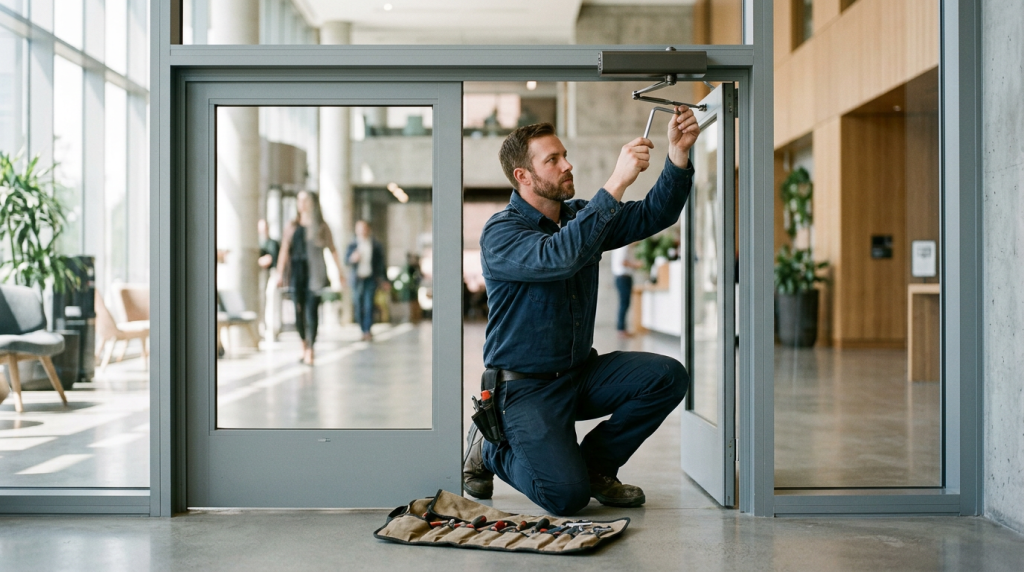
Closer tension, hinge alignment, and latch strike contact are the three checks that decide whether an opening needs an adjustment, a hardware retrofit, or a full replacement.
Four ways to keep openings working, each with the standard or documented figure that governs it. Recommendation: make scheduled inspections your baseline, retrofit hardware before re-hanging any door, and reserve full replacement for frames that no longer hold hardware or for damaged labeled fire-rated assemblies.
| Option or Alternative | Best For | Governing Standard or Documented Figure | Practical Tradeoff |
| Reactive call repair | Low-traffic openings and one-off hardware failures | A door cycled 3 to 5 times per day may still need major part replacement within 5 to 10 years, and repair costs increase once wear accelerates, per Trillium’s commercial door guide | Lowest cost per visit, but an unadjusted sticking door can warp a frame and convert a cheap fix into a full replacement |
| Scheduled preventive inspection rounds | Facility-wide door sets, including overhead, rolling steel, and fire-rated openings | Criteria come from the project hardware schedule, Section 08710 Door Hardware, plus BHMA A156 series standards, while NFPA 80 governs fire doors and windows, per the Kaba access control specification | Highest scheduled labor commitment, yet it is the alternative that catches misalignment and closer failures while they remain adjustments |
| Electrified locking retrofit | Exit doors that need code-approved electrical locking or controlled egress | IBC sections 1010.1.9.7 through 1010.1.9.10 cover these systems, and section 1010.1.9.7 requires unlocking upon loss of power to the locking system, per electrical locking code sections | Adds a power dependency, so a failed supply or a damaged transfer now interrupts both security and daily traffic |
| Credential-based access upgrade | High-risk openings and facilities hosting federal or regulated tenants | Special Publication NIST SP 800-116 Rev. 1 gives a risk-based strategy to select appropriate PIV authentication mechanisms as expressed within FIPS 201, per NIST facility access guidelines | Readers, credential media, and power transfer hardware enlarge the upkeep list, so schedule them alongside closers and strikes |
Ready to Secure Your Doors?
When your commercial door maintenance schedule exposes worn closers, sagging hinges, or failing locks, CSL repairs and replaces the hardware, then rechecks every opening against your facility’s overall security needs. Our certified technicians have served commercial property owners since 1995, so doors, frames, and access control points get fixed correctly the first time, with no surprises. Request a free quote, and we will repair whatever your checklist flags across the whole building, with emergency service day or night.
Commercial Safe & Lock brings a family-owned team, operating since 1995, to that door upkeep decision, comparing repair, retrofit, and replacement instead of defaulting to replacement, with a satisfaction guarantee behind the recommendation.
That is where Commercial Safe & Lock fits: a family-owned security and locksmith team since 1995, focused on commercial door and hardware repair and installation, with a satisfaction guarantee and free quotes before the work starts.
Frequently Asked Questions
What does a door upkeep program actually cover?
A: It is the routine inspection, lubrication, and repair work that keeps doors working as expected, with the goal of catching wear early and fixing it before it interrupts operations. Day to day that means checking hinges, closers, locks, rollers, and tracks, then servicing automatic operators, sensors, and access hardware. The same scope applies to overhead, rolling steel, fire-rated, and standard entry openings.
How often should a door upkeep schedule run?
A: Frequency follows how hard each opening works, not one universal interval. Entries that are opened hundreds or even thousands of times a day, weather-exposed doors, and fire-rated assemblies wear fastest and deserve the shortest cycle, while low-traffic stairwell and storage openings can go longer between checks. Skip the cycle and the consequences compound quickly: wear accelerates, repair costs rise, and a stuck door can block access to a critical area within seconds.
Which warning signs mean a door needs attention now?
A: Noise, misalignment, and lock failure top the list. A grating squeak usually means hinges need lubrication or replacement, because rust and dirt build up over time and make the door harder to move smoothly. If someone has to shove a door to open it, alignment has drifted as the building settled or hinges loosened. A quick adjustment now is far cheaper than the warped frame and full replacement that follow when it waits.
Why won’t a commercial door close or latch?
A: Follow the door and locate the point where its movement breaks down. Common causes are sagging on worn or loose hinges, binding against the frame or threshold, and a closer that is swinging the door incorrectly, with latch, strike, and release hardware next in line. A service diagnosis that tracks the opening from free swing through alignment, latching, and securing usually identifies the failing part before anyone quotes a replacement.
Do building codes and accessibility rules change how doors should be serviced?
A: Yes, and they turn minor hardware faults into compliance problems. Hardware on exit openings is regulated: the International Building Code adds requirements for controlled egress locking systems, including unlocking upon loss of power to the locking system, in section 1010.1.9.7. Worn or poorly installed doors can also lead to ADA and other building code violations, and specification guidance referencing NFPA 80 requires door and hardware to stay tested as an assembly so labeling requirements hold.
What happens when upkeep is put off for a year or two?
A: The cost arrives in three waves: premature wear, repairs that would once have been small, and full replacements that never needed to happen. Malfunctioning doors also weaken security and can push energy costs up when they no longer close and seal the way they should. Facilities that run a proactive checklist avoid most of that, because maintained doors simply stay in service longer.
Should facility staff handle door upkeep in-house, or bring in a professional?
A: Split the work by risk. On-site teams can keep thresholds and tracks clear, run the visual walk-through, and log what changes between inspections. Anything that alters how a door swings, latches, locks, or holds a fire rating belongs with professionally trained and certified technicians.